











Tooth retention is almost always the preferred option. However, in some cases, removing a tooth may be recommended. At Genesis Dental, we provide tooth extraction Perth patients can trust, with a focus on clear communication and your long-term wellbeing.
Our experienced team will assess your situation carefully, explain your options in plain English, and answer your questions.
In many cases, tooth removal can be avoided with early treatment (such as root canal) and regular care. That is why routine dental check-ups are so important. They allow your dentist to assess your oral health, monitor changes over time, and step in early when problems arise.
If a tooth becomes severely damaged, infected, or starts causing pain or complications, extraction may be recommended. Our caring team will always explore other treatments first and only advise removal when it is genuinely in your best interest.
If you are experiencing discomfort or have concerns about a problem tooth, an early assessment can help prevent further issues and support better long-term outcomes.
Not all tooth extractions are the same. The type of procedure recommended will depend on the position of the tooth, the extent of damage or infection, and your overall oral health.
At Genesis Dental, we carefully assess your individual situation before recommending the most appropriate approach.
Simple tooth extractions
Performed when the tooth is fully visible above the gum line. These extractions are commonly used for teeth that are loose, damaged, or affected by decay and are usually performed under local anaesthetic.
Surgical tooth extractions
Required when a tooth is impacted, broken below the gum line, or difficult to access, such as some wisdom teeth.
Your dentist will explain which type of extraction is required and what to expect during treatment.
However, teeth may be extracted due to dental complications or in order to prevent further problems. A painful, impacted wisdom tooth or an infected tooth may cause serious issues that need to be treated through extraction.
Teeth are extracted for a variety of reasons, such as:
Your understanding is our priority throughout the tooth extraction process. Before any treatment begins, your dentist will carefully assess your tooth and discuss the procedure with you so you know exactly what to expect.
In most cases, the process involves:
A thorough examination of the tooth and surrounding area
X-rays if needed to assess the tooth and plan the extraction
Local anaesthetic to numb the area
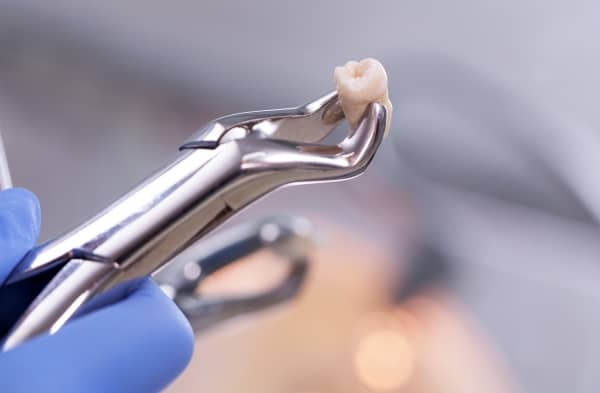
Removal of the tooth using appropriate techniques
Clear guidance on aftercare and recovery before you leave the clinic
Our team will take the time to answer your questions.
Through each step of the process, we’ll explain your options and answer your questions.
After a tooth extraction, some tenderness or swelling is normal as the area begins to heal. Our team will provide you with clear aftercare instructions to follow during recovery.
In most cases, recovery involves:
Allowing time for the area to clot and heal
Managing mild swelling or discomfort with recommended care
Avoiding strenuous activity for the first day or two
Eating soft foods while the area settles
Keeping the area clean as advised by your dentist
For meal ideas after wisdom tooth removal, see our day-by-day guide to eating after wisdom teeth removal.
Healing times can vary depending on the type of extraction and your individual circumstances. Your dentist will let you know what to expect and when normal activities can be resumed.
If you experience increasing pain, swelling, or have any concerns during your recovery, our team can provide guidance.
For a basic procedure, the estimated price ranges from $120 to $200 for each tooth.
If the extraction is more complicated and requires surgical intervention, the cost increases, averaging between $285 and $400 per tooth.
For an accurate quote, enquire with our team.
Our dentists are members of reputable dental associations, including the Australian Dental Association WA (ADAWA). We are also accredited by QIP, meaning our practice adheres to industry guidelines and regulations.
We accept all health funds, claimable on the spot for your convenience. We are preferred providers with HBF, HCF, CBHS, HIF, and NIB, meaning you can maximise your rebate.
We also offer interest-free payment plan options through The Tooth Market’s Fund My Dental, as well as Humm payment options for eligible patients. We also participate in government-supported programs such as the Child Dental Benefits Schedule and provide dental care for eligible Department of Veterans’ Affairs (DVA) card holders.


At Genesis Dental, our team will explain your tooth extraction options.
Our caring team focuses on:
Clear communication so you understand your options and treatment plan
Discussion of the procedure
Individualised care tailored to adults and children
Dental equipment and clinical methods
Ongoing support before, during, and after your appointment
Principal Dentist, DEN0001784829
Principal Dentist, DEN0002667701
Principal Dentist, DEN0001995824
General Dentist, DEN0001596442
General Dentist, DEN0001595856
General Dentist, DEN0002897678
General Dentist, DEN0004042774
General Dentist, DEN0002315983
General Dentist, DEN0002441704
Oral Health Therapist, DEN0002675019
Contact our trusted and friendly dentist in Canning Vale to find out about tooth extractions.
We handle your details in line with our Privacy Policy.
What is the recovery process like after tooth extraction?
Does tooth extraction require an overnight stay?
No, tooth removal does not require an overnight stay.
Can I prevent tooth extraction?
Regular dental checkups and a good oral hygiene routine go a long way in preventing oral health complications that require tooth extraction. However, some scenarios are unavoidable and require tooth extraction.
How long does tooth removal take?
The length of the tooth removal process varies depending on the situation, but the process typically takes 20 minutes or less.
What are tooth extractions?
Tooth extractions involve the removal of one or several teeth.
Most tooth extraction procedures can be done in the regular dental chair.
We answer your questions, explain what to expect, and provide an after-care plan.
In cases of severe dental anxiety, we would be happy to discuss the use of a sedative with you.